How to Tailor Resume to Job Description and Land More Interviews
To get your resume noticed, you have to do more than just list your experience. It's about meticulously dissecting the job description, mirroring its language, and backing up your claims with hard numbers that speak directly to what the company needs. This isn't just about tweaking a word here or there; it's a strategic move to get past the automated gatekeepers and show a real person you're the perfect fit.
Why Your Generic Resume Is Getting Ignored
Let's be real for a second—the "one-size-fits-all" resume is a relic. Firing off the same document for every single job opening is like trying to open a door with the wrong key. It just won’t work. Today’s hiring world moves incredibly fast, and your application has just a few seconds to make its case. Customizing your resume isn't just a nice-to-have; it's the single most important thing you can do.
You need a new mindset. Stop thinking of your resume as a historical record of your career. Instead, see it as a direct sales pitch, answering a company's immediate problem. A generic resume is all about you. A tailored one speaks to the employer and frames you as the solution they’ve been looking for.
The Modern Hiring Gauntlet
The way companies screen candidates has completely changed. An average job post pulls in about 250 resumes, and recruiters only spend a frantic 6 to 8 seconds on each one. With a window that small, they're not digging for gold; they're scanning for instant signs of a match.
It gets tougher. A staggering 75% of resumes get tossed out by Applicant Tracking System (ATS) software before a human ever lays eyes on them. This digital filter makes it painfully clear why a generic approach is a dead end.
You're up against two very different audiences:
- The Applicant Tracking System (ATS): A robot looking for a keyword match against the job description.
- The Human Recruiter: A busy person quickly scanning for proof that you can actually do the job.
A generic resume tries to appeal to everyone, which means it ends up connecting with no one. Tailoring is a deliberate strategy. It proves you’ve done your homework and are genuinely interested in this specific role at this specific company. It's the difference between shouting into a crowd and having a direct, meaningful conversation.
Proving You Are the Solution
When you don't customize your resume, you're making the recruiter do all the heavy lifting. They’re left trying to figure out how your "Project Management" experience lines up with their need for an "Agile Scrum Master."
A tailored resume connects those dots for them. It explicitly maps your skills to their advertised needs. You can learn more about exactly what employers look for in resumes in our detailed guide. This effort shows you're professional, detail-oriented, and truly want the job—all things that every employer values.
Ultimately, tailoring your resume is how you prove you’re the answer to their problem.
How to Decode Any Job Description
Think of the job description as the company’s cheat sheet. Seriously. They’re laying out every single thing they need, the exact person they want to hire, and what a "win" looks like in the role. Your job isn't to read their minds; it's to break down their request and show them you’re the answer they've been looking for.
Getting this right is the absolute first step.
Before a human recruiter even sips their morning coffee and sees your resume, it’s almost certainly going to face an Applicant Tracking System (ATS). This is a purely robotic first pass, and its only job is to scan for specific keywords and qualifications. If you don't play its game, you're out before you're even in.
This chart shows you exactly what you’re up against—a funnel that gets smaller and smaller at each stage.
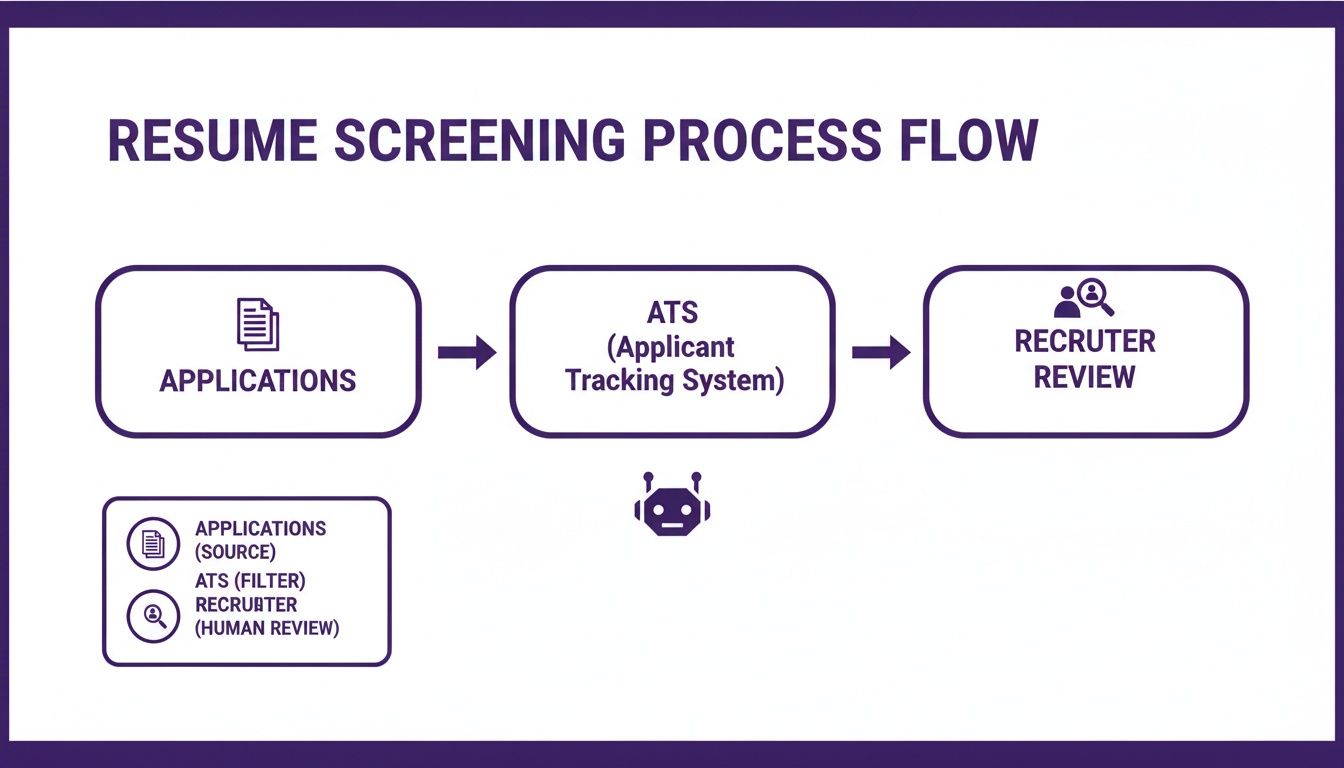
This is why just hitting "submit" is never enough. You have to optimize your resume to beat the bot before you can impress the person.
Must-Haves vs. Nice-to-Haves
First things first, you need to sort the non-negotiables from the bonus points. Companies toss in a mix of essential duties and "dream" qualifications. Your ability to tell them apart is a game-changer.
- Must-Haves: These are the deal-breakers. Look for direct, unmistakable language like "required," "minimum of 5 years," "must have experience with," or "proficiency in." These are the exact keywords the ATS is programmed to hunt for.
- Nice-to-Haves: These are the icing on the cake. They usually show up with softer phrases like "preferred," "a plus," "familiarity with," or "bonus if." Lacking these won't knock you out of the running if your must-haves are solid.
I always tell people to print the job description or copy it into a doc. Then, grab two different colored highlighters and physically mark the must-haves versus the nice-to-haves. This simple trick gives you an instant visual of what to focus on.
Build Your Keyword Map
Now that you have your highlighted doc, it's time to build your "keyword map." This is your blueprint for tailoring your resume, turning the company's language into your action plan.
I like to create a simple table to group keywords into categories. It’s a super effective way to make sure you're hitting all the right notes across your entire resume.
Here’s a sample breakdown for a Marketing Manager role. It shows you how to dissect a job description and figure out exactly where each keyword should go on your resume.
Job Description Keyword Analysis for a Marketing Manager Role
| Keyword Category | Keywords Found in Job Description | Where to Add on Your Resume |
|---|---|---|
| Hard Skills | SEO strategy, Google Analytics, CRM software, content creation, market research | Skills section, work experience bullet points |
| Soft Skills | Team leadership, communication, strategic planning, problem-solving | Professional summary, woven into work experience descriptions |
| Responsibilities | Manage campaigns, analyze performance metrics, develop marketing plans | Work experience bullet points using strong action verbs |
This map is more than a list; it’s a strategic guide. It tells you which terms need to be there and where they'll have the biggest impact, making sure both the ATS and the recruiter see a perfect match.
If you do this and realize you're coming up short on some key qualifications, don't panic. It's a great opportunity to think about professional development. We have a guide that offers some great insights on how to identify skill gaps and what to do about them.
Tune In to the Company's Vibe
Beyond just the keywords, the way a company writes tells you a ton about its culture. Is the tone super formal and corporate? Or is it laid-back, maybe even a little quirky?
Read between the lines. A post that talks about "joining our family" and "wearing many hats" screams fast-paced startup. On the other hand, one that emphasizes "adherence to established protocols" signals a more structured, buttoned-up environment.
Mirroring this tone—especially in your professional summary—is a subtle but powerful move. It shows you get them.
If they use specific industry jargon, you should use it too (as long as you actually know what it means!). This little adjustment makes you sound like an insider before you've even had a conversation. It's a small detail that can make a surprisingly big difference.
Alright, you've done the detective work and mapped out the keywords from the job description. You’re no longer shooting in the dark—you have a blueprint for what the hiring manager wants to see.
Now comes the fun part: strategically weaving those keywords and themes into every section of your resume. This isn't about keyword-stuffing. It's about methodically rebuilding your resume to tell a story that aligns perfectly with the role.
And this isn't just theory. The data backs it up. One analysis of over a million applications found that just matching your resume title to the job title can make you 3.5 times more likely to get an interview. On top of that, 83% of recruiters say they're more likely to hire someone who’s customized their resume for the job.

Transform Your Professional Summary
Your professional summary is your elevator pitch. It’s the trailer for your career movie, and it has to be compelling enough to make the recruiter stick around for the main feature. A generic summary is an instant turn-off.
Your goal is to write a punchy, 3-sentence narrative that directly reflects the top priorities mentioned in the job ad.
Let's walk through a real-world example. Say you're applying for a "Senior Content Strategist" position that's laser-focused on "SEO-driven content," "data analysis," and "cross-functional team leadership."
Before (The Generic Approach):
"Highly motivated and experienced content professional with a proven track record of creating engaging materials for various platforms. Skilled in writing, editing, and managing content calendars to meet business objectives. Seeking a challenging role to utilize my creative and communication skills."
This is fine, but "fine" doesn't get you hired. It’s so vague it could apply to almost any content job out there.
After (The Tailored Approach):
"Senior Content Strategist with 8+ years of experience developing SEO-driven content frameworks that increased organic traffic by 150% for SaaS companies. Proficient in using Ahrefs and Google Analytics to translate data insights into actionable content plans. Collaborative leader adept at guiding cross-functional teams of writers, designers, and marketers to execute cohesive brand narratives."
See the difference? This version is a direct answer to the job ad. It uses their exact job title, folds in keywords like "SEO-driven content," and backs it up with a hard number. For more tips, check out our guide on what to include in a resume summary.
Reframe Your Work Experience with the STAR Method
The work experience section is where you deliver the proof. Stop just listing your job duties. Instead, frame your accomplishments in a way that shows you've already solved the kinds of problems this employer is facing.
The STAR method (Situation, Task, Action, Result) is the absolute best way to do this. It transforms a boring duty into a powerful story of your impact.
- Situation: What was the challenge or project environment? (Set the scene.)
- Task: What was your specific goal?
- Action: What did you actually do? Start with a strong action verb.
- Result: What happened because of your actions? Use numbers to prove it.
It's also worth noting that your word choice can make a huge difference. Taking some time for mastering diction to elevate your writing can help you sound more professional and impactful.
Key Takeaway: Recruiters don't just care about what you did. They want to know how well you did it. Numbers are the language of business, and they make your value crystal clear.
Let's apply this to a Project Manager role that specifically asks for someone who can "improve project efficiency" and "manage budgets."
Before (Duty-Focused):
- Responsible for managing project timelines.
- Handled project budgets and resource allocation.
- Led team meetings and communicated with stakeholders.
This just tells the recruiter your job description. It doesn't tell them if you were any good at it.
After (STAR Method & Quantified):
- Revamped project workflow by implementing Agile methodologies (Action), slashing average project completion time by 20% over six months (Result).
- Managed a $500K project budget (Task) and strategically reallocated resources to cut costs by 15% without sacrificing quality (Result).
- Led weekly stakeholder meetings for a 12-person cross-functional team (Situation), boosting communication and ensuring project milestones were hit on time, every time (Result).
The "after" version is packed with proof. It uses strong verbs and, most importantly, provides the metrics that speak directly to the "efficiency" and "budget management" requirements in the job description.
Curate a Targeted Skills Section
Your skills section is not the place to dump every piece of software you’ve ever used. Think of it as prime real estate that needs to be optimized for both the ATS and the recruiter scanning your resume.
Pull the most important skills directly from the keyword map you created earlier.
A huge mistake I see all the time is one long, messy list of skills. A much better approach is to break them down into categories. It makes your qualifications much easier to digest.
Here’s how you could structure it for a "Data Analyst" role that needs a mix of technical and soft skills.
Example Skills Section for Data Analyst
| Category | Skills from Job Description |
|---|---|
| Technical Skills | SQL, Python (Pandas, NumPy), Tableau, Microsoft Power BI |
| Data Analysis | Statistical Analysis, Data Modeling, A/B Testing, Data Visualization |
| Soft Skills | Problem-Solving, Communication, Stakeholder Management |
This simple categorized format accomplishes two critical things:
- It’s ATS-friendly, making it easy for the system to find keyword matches.
- It’s human-friendly, letting a recruiter see your most relevant skills in a 5-second scan.
By systematically applying these changes, you’re no longer just sending a resume. You're submitting a tailored, data-backed argument for why you’re the perfect fit for the job.
Beating the Bots and Impressing Recruiters
Knowing how to sprinkle keywords from the job description into your resume is a great start, but it's only half the battle. Your resume has to win over two very different audiences: first, the Applicant Tracking System (ATS), and second, the human recruiter who has about six seconds to spare.
If you can't get past both, your carefully crafted application disappears into a digital black hole.
Think of the ATS as a bouncer at an exclusive club. It’s not there to appreciate your unique qualities; its only job is to check your resume against a specific list of keywords and a readable format. If you don't meet the bot's strict criteria, you're not getting in.
Creating an ATS-Friendly Format
The single biggest mistake I see candidates make is getting too creative with formatting. Fancy tables, columns, headers, footers, or slick graphics can completely scramble an ATS's ability to read your information.
When the software can't parse your resume, it assumes the crucial information simply isn't there.
Stick to these simple formatting rules to make sure the bots can actually read your file:
- File Type: Unless the application specifically asks for something else, always submit your resume as a .docx or .pdf. These are the gold standard and the most universally readable formats.
- Fonts: Go with standard, web-safe fonts like Arial, Calibri, Times New Roman, or Helvetica. That cool custom font you found might look great on your screen, but it can cause major parsing errors on the other end.
- Structure: A clean, single-column layout is non-negotiable. ATS software often reads from left to right, line by line. If you use multiple columns, it will mash all your text together into an unreadable mess.
Your resume’s design needs to be functional first and aesthetic second. A clean, simple format isn't boring—it’s a strategic choice to ensure the software that stands between you and a human reviewer can actually understand your qualifications.
For a much deeper dive on this, our guide on applicant tracking system resume tips covers all the nuts and bolts.
Pleasing the Human Eye
Once your resume clears the ATS hurdle, it finally lands in front of a real person. But here's the catch: studies consistently show recruiters spend an average of just seven seconds on their initial scan.
Your entire goal is to make those seven seconds count.
This is where thoughtful, clean design makes all the difference. You want to guide the recruiter's eye directly to your most impressive, relevant qualifications without making them work for it. A clean layout isn't just for the bots; it's critical for human readability. White space is your best friend—it breaks up text and makes your resume feel less intimidating to a hiring manager drowning in applications.
Guiding the Recruiter's Attention
Smart formatting isn't just about looking good; it's about controlling the narrative. You can highlight your most powerful achievements and make it impossible for a recruiter to miss why you're a great fit.
Here’s how to do it without going overboard:
- Use Bold Text Sparingly: Make key information pop. Bold your job titles, company names, and critical metrics (like “Increased Q4 revenue by 25%”). If you bold everything, nothing stands out.
- Leverage Bullet Points: Nobody wants to read a dense paragraph of text. Use bullet points to frame your accomplishments in a quick, digestible format that’s easy to scan.
- Clear Section Headings: Stick to simple, direct headings like "Work Experience," "Education," and "Skills." This creates a logical flow and helps recruiters find exactly what they’re looking for in seconds.
By combining an ATS-friendly structure with a clean, human-readable design, you create a resume that excels at its one true purpose: getting you noticed. Once it opens that door, resources on navigating job interviews can be incredibly helpful for that next step, especially for neurodivergent candidates. Your resume gets you the interview; your preparation helps you nail it.
Want to Stop Wasting Time Tailoring Your Resume?
Let’s be honest, tweaking your resume for every single job application is a soul-crushing grind. Analyzing job descriptions, hunting for keywords, and rewriting bullet points over and over again feels like a full-time job in itself. It’s not just tedious; it's also easy to miss something important.
But what if you could slash that time from hours down to just a few minutes?
This is where a smarter workflow makes all the difference. Instead of reinventing the wheel for every application, you can let technology handle the grunt work. This frees you up to focus on what really matters—networking, preparing for interviews, and actually talking to people.
Ditch the Manual Keyword Hunt
The first step in tailoring your resume—picking apart the job description—is also the most boring. Sure, you can manually highlight keywords, but it's slow and you're bound to miss a few. A dedicated tool can do this instantly, taking all the guesswork out of the equation.
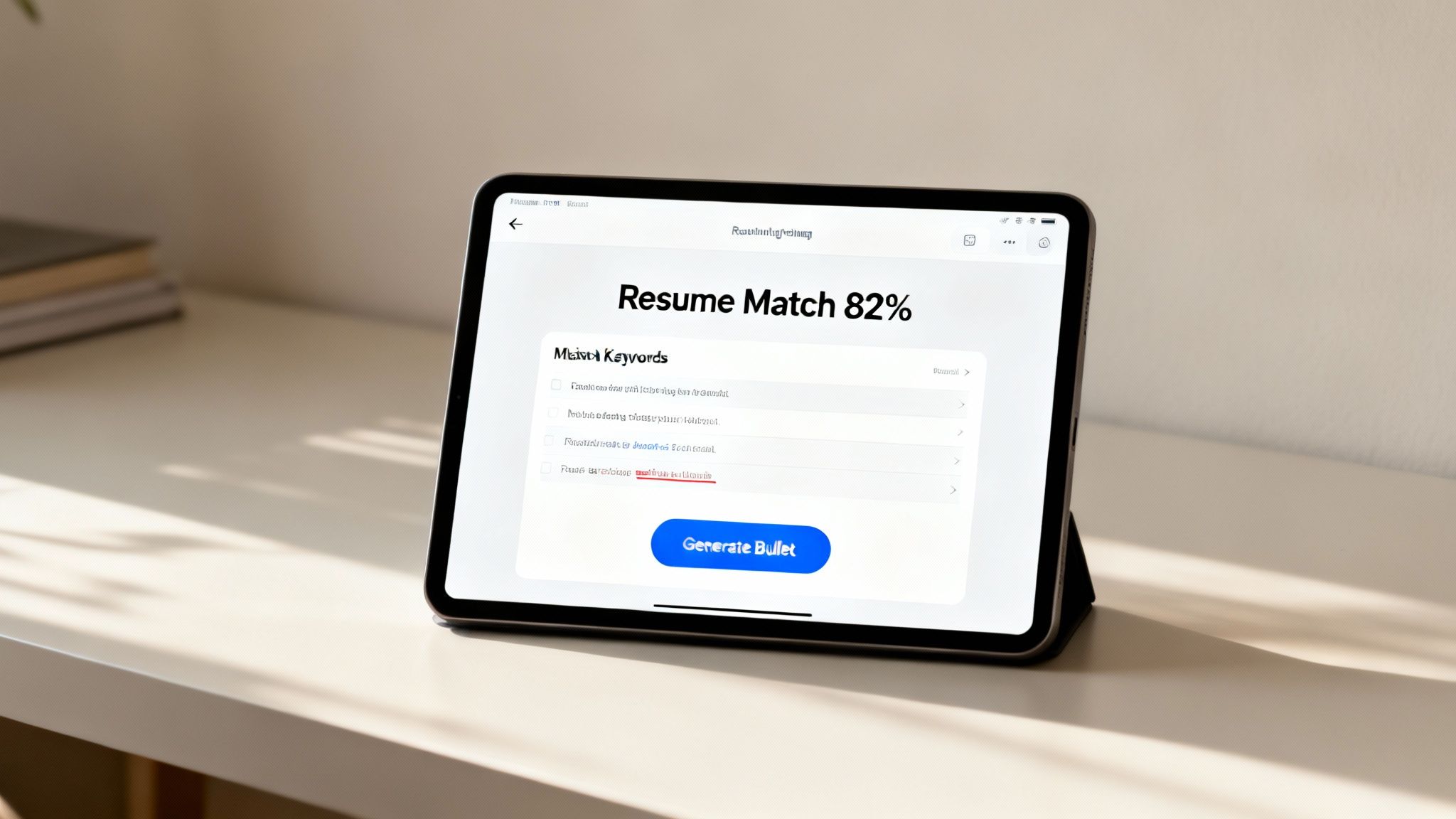
For example, Eztrackr’s skill-match analyzer puts your resume and a job description head-to-head in seconds. It gives you a straight-up score, showing you exactly how well you stack up against what they're looking for.
Better yet, it tells you:
- What’s Missing: You’ll immediately see which critical skills and qualifications from the job post are nowhere to be found on your resume.
- Keyword Gaps: It helps you understand if you’ve used the most important terms enough to get past the initial ATS filter.
This kind of instant feedback is like having a cheat sheet for every application. You get a clear, actionable list of what to add to boost your score and get noticed by both the bots and the humans.
Get AI to Write Your Bullet Points
Once you know which keywords to add, you still have to weave them into your resume naturally. This is where most people get stuck, especially in the work experience section. You want it to sound impressive and results-driven, not just like you copied and pasted a list of skills.
Think about it: for nearly 70% of recruiters, your work history is the single most important part of your resume. And 75% of hiring managers are looking for specific, quantified achievements. A generic, untailored resume is a massive red flag. You can find more eye-opening resume stats over at Enhancv.com.
This is where AI-powered resume builders are a game-changer. With a tool like Eztrackr, you can use the built-in AI to generate brand-new, tailored bullet points based on the specific job you’re applying for.
The tool helps you frame your accomplishments in a way that speaks directly to the employer’s pain points. It saves you from the headache of trying to rephrase the same achievement for the tenth time.
The Real Advantage: Using an integrated system isn't just a time-saver. It’s about making smarter, data-driven decisions for every single application. You're ensuring that every resume you send out is strategically optimized, which seriously increases your chances of landing an interview without burning out.
Imagine cutting your application time from three hours down to 30 minutes. By building a better process, you can apply to more of the right jobs with a much higher-quality, better-targeted resume. That efficiency is what keeps you going and builds confidence throughout your job search.
Common Questions About Resume Tailoring
Even with a solid plan, tailoring your resume for every job can feel a bit… much. It’s easy to get bogged down in the details or wonder if you’re spending way too much time on a single application.
Let's walk through some of the most common questions job seekers have. Getting these answers straight will help you move forward with confidence, making sure every resume you send is a powerful, targeted document. It’s all about working smarter, not harder.
How Much Time Should I Spend Tailoring Each Resume?
This is the big one. The honest answer? It depends, but it shouldn't take over your life.
A good rule of thumb is to aim for 30 to 60 minutes to customize your resume for a role you're actually excited about. If you find it's taking hours, you might need to rethink your process.
Your first few attempts will definitely feel slow. But once you get the hang of dissecting job descriptions and tweaking your core resume, you'll find your rhythm. The goal isn't to create a perfect, handcrafted masterpiece every time; it’s about making a significant leap from a generic, one-size-fits-all application.
Remember, spending 45 minutes on a highly targeted resume that actually gets you an interview is a much better use of your time than shotgunning 10 generic ones in the same amount of time.
Do I Really Need a Different Resume for Every Single Job?
Yes and no. You absolutely do not need to rewrite your resume from scratch every time. That’s a one-way ticket to burnout.
The secret is to build a detailed "master resume." Think of it as your personal career library, packed with every project, skill, and quantified achievement you’ve ever had.
For each new application, you’ll just make a copy of this master document. Then, you can strategically edit, prune, and reorder things to perfectly mirror what the new job description is asking for.
This usually looks like:
- Swapping out your professional summary to reflect the job's top priorities.
- Shuffling the bullet points in your work experience to put the most relevant wins right at the top.
- Tweaking your skills section to include specific keywords from the ad.
Is It Dishonest to Change My Job Title to Match the Posting?
This is a gray area, for sure. The short answer is: never lie, but you can absolutely clarify.
Let’s say your official, internal title was "Client Solutions Associate," but your day-to-day work was a perfect match for a "Customer Success Manager" role. In that case, it’s often fine to use the more common, descriptive title that recruiters will actually search for. They know internal titles can be weird and specific to the company.
In fact, a study from Jobscan found that matching the job title on your resume to the one in the posting can boost your interview chances by more than 10 times.
Here’s a totally safe way to do it:
- Original Title: "Member Services Specialist"
- Job Posting Title: "Account Manager"
- What you write on your resume: Account Manager (Official Title: Member Services Specialist)
This approach is both honest and optimized for the ATS. It gets you the keyword match you need without being dishonest about your history, and it helps the recruiter immediately see how your experience fits their opening.
Stop the manual grind and let AI do the heavy lifting. With Eztrackr, you can analyze job descriptions, get a match score, and generate tailored bullet points in minutes. Take control of your job search and start landing more interviews by visiting https://eztrackr.app today.