How to Overcome Interview Anxiety and Land the Job
Let's be honest: trying to completely eliminate interview nerves is a losing battle. The real key to overcoming interview anxiety is learning how to manage it. It's about turning that frantic, shaky energy into focused excitement. This shift happens when you get strategic with your preparation, reframe your mindset, and have a few calming tricks up your sleeve for the big day.
Why Interview Anxiety Is Normal (and How to Tame It)

If your heart starts racing and your palms get clammy just thinking about an interview, congratulations—you're human. An interview is, by its very nature, a high-stakes performance. You're being judged, and that alone is enough to kick your body's "fight-or-flight" response into high gear. This ancient survival mechanism is great for outrunning a tiger, but not so great for calmly explaining your five-year plan.
It's that combination of intense performance pressure and the fear of saying the wrong thing that creates the perfect storm for stress. You're not just having a chat; you're trying to sell yourself and prove your worth in a very short window of time. It’s an incredibly common feeling, not a sign that you're unprepared or weak.
You're Definitely Not Alone in This
It can feel like you're the only one whose mind goes blank when the interviewer asks, "So, tell me about yourself." But the reality is that nearly everyone gets nervous.
Think about this: a JDP survey found that a staggering 93% of job seekers experience interview anxiety. It's so common that interviews are often ranked as the second most stressful activity right after public speaking—beating out the stress of a first date. If you're curious, you can dig into more job interview statistics that paint the full picture.
The goal isn't to walk in feeling nothing. A little adrenaline can actually be a good thing! It can sharpen your focus and make you seem more passionate and engaged. The trick is to keep it from spiraling out of control.
The secret to a great interview isn't the absence of anxiety, but the ability to perform well in spite of it. Try to think of those nerves as fuel—a clear sign that you really care about this opportunity.
Pinpoint Your Personal Triggers
To start managing your anxiety, you first have to know what's causing it. What specifically sends your stress levels through the roof? For some, it's the dread of being stumped by a tough question. For others, it’s the pressure of making that perfect first impression. Once you name your fears, you can start building a plan to tackle them.
This short guide helps identify some of the most common interview fears and gives you a practical, immediate solution for each one. Think of it as your quick-reference cheat sheet for calming the nerves.
Common Interview Stress Triggers and Actionable Solutions
| Anxiety Trigger | What It Feels Like | Quick Solution |
|---|---|---|
| Fear of the Unknown | "What if they ask me something I can't answer? What if the interviewer is intimidating?" | Research! Look up common questions for your role and practice your answers. Find your interviewers on LinkedIn to put a face to the name. |
| Imposter Syndrome | "I'm not actually qualified for this. They're going to find out I'm a fraud." | Review the job description and list every requirement you meet. Write down 3-5 specific accomplishments from your resume that prove you're capable. |
| Pressure to Be Perfect | "If I stumble over one word or forget one detail, it's all over." | Reframe your goal from "perfection" to "connection." Focus on building rapport and showing your genuine interest. Remember, interviewers are human, too. |
| Past Bad Experiences | "My last interview was a disaster. This one will probably go the same way." | Acknowledge the past experience, but don't let it define your future. Focus on what you can control this time: your preparation and your mindset. |
Identifying your specific triggers is the first real step. It turns that vague, overwhelming sense of dread into a list of smaller, manageable challenges you can start working on right now.
Build Confidence Through Strategic Preparation
There's no magic pill for interview anxiety, but the closest thing we have is rock-solid preparation. I'm not talking about a quick glance at the company's "About Us" page five minutes before the call. True confidence comes from methodically breaking down the role and anticipating what's coming.
When you prepare strategically, you shift your entire mindset. You stop thinking, "I hope they like me," and start asking, "Is this the right fit for me?" That small change puts you back in control, and control is a powerful antidote to fear. The unknown is scary; a well-lit path isn't.
Dissect the Job Description Like a Detective
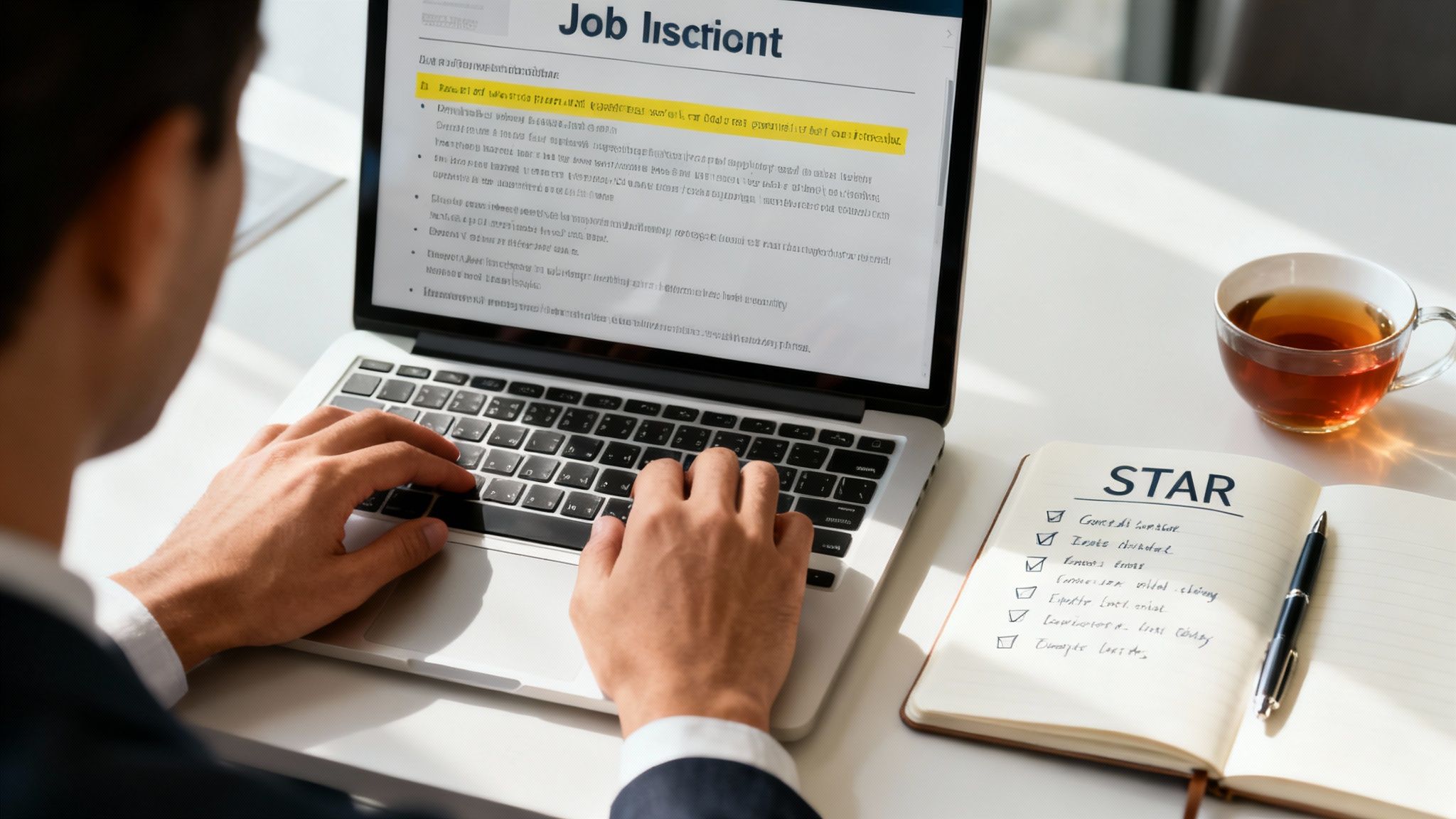
Think of the job description as your cheat sheet. It's a map pointing directly to the questions they're going to ask. Don't just skim it—print it out, grab a highlighter, and really dig in.
- Spot the Core Duties: What are the top 3-5 responsibilities they list? You can bet your bottom dollar they'll form the basis of questions like, "Tell me about a time you managed a complex project."
- Pinpoint Key Skills: Look for specific tools, software, or methodologies (like Agile or Scrum). Also, note the soft skills they mention, like "cross-functional collaboration." You'll need a story for each.
- Listen for Their Language: Do they keep using words like "innovation," "customer-centric," or "data-driven"? Weave these same terms into your answers. It shows you get them and their culture.
This kind of analysis turns vague anxiety into a concrete plan. If you want to go even deeper, our full guide on how to prepare for a job interview has you covered.
Craft Your Stories with the STAR Method
Okay, so you know what they're going to ask. Now what? You need to have your answers ready, and the STAR method is your best friend here. It’s a simple framework that stops you from rambling and makes sure your stories have a real punch.
It's a simple acronym:
- Situation: Briefly set the scene. Where were you? What was the context?
- Task: What was your specific goal or responsibility?
- Action: This is the most important part. What specific steps did you take?
- Result: What was the outcome? Use numbers here whenever you can.
Instead of a weak claim like "I improved efficiency," a STAR answer sounds like this: "By implementing a new project tracking system (Action), I cut down our weekly reporting time by 20% (Result)." See the difference? One is forgettable, the other is a memorable win. Of course, even the best stories can be tripped up by self-doubt, which is why overcoming imposter syndrome at work is a crucial part of your mental prep.
Your best interview answers are not memorized scripts; they are well-rehearsed stories. Aim to have 5-7 solid STAR stories ready to go—these are your greatest hits.
Modern tools can give you a serious edge here. An AI Answer Generator can help you practice your delivery, while a Skill-Match Analyzer can show you exactly where your experience lines up with the job description. This kind of systematic prep replaces that "what if I freeze up?" feeling with a quiet confidence that you're ready for anything they throw at you.
Rewire Your Mindset for Interview Success
Anxiety doesn't just live in your stomach; it starts as a whisper in your mind. Those nagging thoughts like "What if I blow it?" or "I'm just not good enough" can spiral out of control, hijacking your confidence before you even walk in the door. The real key to beating interview anxiety is learning how to catch and challenge these internal narratives head-on.
This isn't about slapping on a fake smile or pretending you're not nervous. It's about consciously shifting your perspective from a place of fear to one of genuine opportunity. Stop seeing the interview as a hostile interrogation and start reframing it as a two-way street. You aren't just being judged; you're also figuring out if this company is a place where you can actually do your best work.
From Threat to Opportunity
Our brains are hardwired to spot threats, and let's be honest, a high-stakes interview can feel like a big one. But you have the power to actively change that perception. The next time a negative thought pops into your head, don't just shove it aside—consciously replace it with something more constructive.
- Instead of: "What if I completely forget my answers?"
- Try: "I've prepared my key stories. If I get stuck, I can take a breath and calmly ask for a moment to think."
That small but powerful adjustment flips the script. You go from being a passive victim of your anxiety to an active participant in the conversation. Techniques from Cognitive Behavioral Therapy (CBT) are fantastic for breaking these automatic negative thought cycles and building a more balanced, positive mindset.
Visualize a Successful Outcome
Top performers—from elite athletes to surgeons—use visualization to get ready for high-pressure situations. And you can, too. This is way more than just wishful thinking; it's a mental rehearsal that primes your brain for success.
A few days before the interview, find a quiet spot. Close your eyes and walk through the entire experience, picturing it going exactly how you want.
- Imagine yourself walking in with a calm, confident posture.
- Picture shaking the interviewer's hand firmly.
- Visualize yourself answering questions clearly and articulately.
- See the conversation flowing naturally, with both you and the interviewer smiling and engaged.
- Finally, imagine leaving the interview feeling genuinely proud of how you handled yourself, no matter the outcome.
By repeatedly running through a positive scenario, you create a mental blueprint for success. When the actual day comes, your brain recognizes the situation as familiar and less threatening, which can significantly reduce your body's stress response.
This mental practice doesn't magically guarantee you'll get the job, but it builds the emotional resilience you need to perform at your best. Honing this skill is a powerful asset that will serve you well throughout your entire career. If you want to dig deeper, you can learn more about how to build emotional intelligence in our detailed guide. Getting your thoughts right is the foundation for turning anxious energy into a focused, positive force.
The Power of Realistic Practice with Mock Interviews
Knowing your key talking points is one thing. Delivering them smoothly when the pressure is on? That's a whole different ball game. Mock interviews are your single best tool for bridging that gap between knowing your stuff and actually performing well.
This isn’t just about memorizing answers. The real goal is to simulate the entire experience, from the awkward small talk to the tough follow-up questions. Find a friend, a mentor, or even a career coach to play the part of the interviewer, and ask them not to break character. The more real it feels, the more it will help calm your nerves when the actual day arrives.
Setting Up a Practice Session for Success
To get the most out of a mock interview, you have to treat it like the genuine article. This gives you a low-stakes environment to work out all the kinks—the fumbled words, the long pauses, the nervous tics—before they have real consequences.
- Dress the Part: Seriously, wear the exact outfit you plan to wear for the real interview. It’s amazing how much this can shift you into the right headspace.
- Use the Same Tech: If you're prepping for a video call, do the practice run on the same platform. Get your camera angle right, test your microphone, and make sure your background is clean.
- Provide a Script: Don't leave your practice partner guessing. Hand them the job description and a list of common questions. For an extra edge, pull some tailored prompts from an interview question generator.
When you’re done, ask for honest, direct feedback. Where did you seem most confident? When did you ramble? Were any of your answers unclear? This feedback is pure gold.
The point of a mock interview isn’t to be perfect. It’s to get all the awkward pauses, fumbled words, and nervous tics out of your system before it actually counts.
Practice is what creates that crucial mindset shift, moving you from a place of fear to one of confidence.
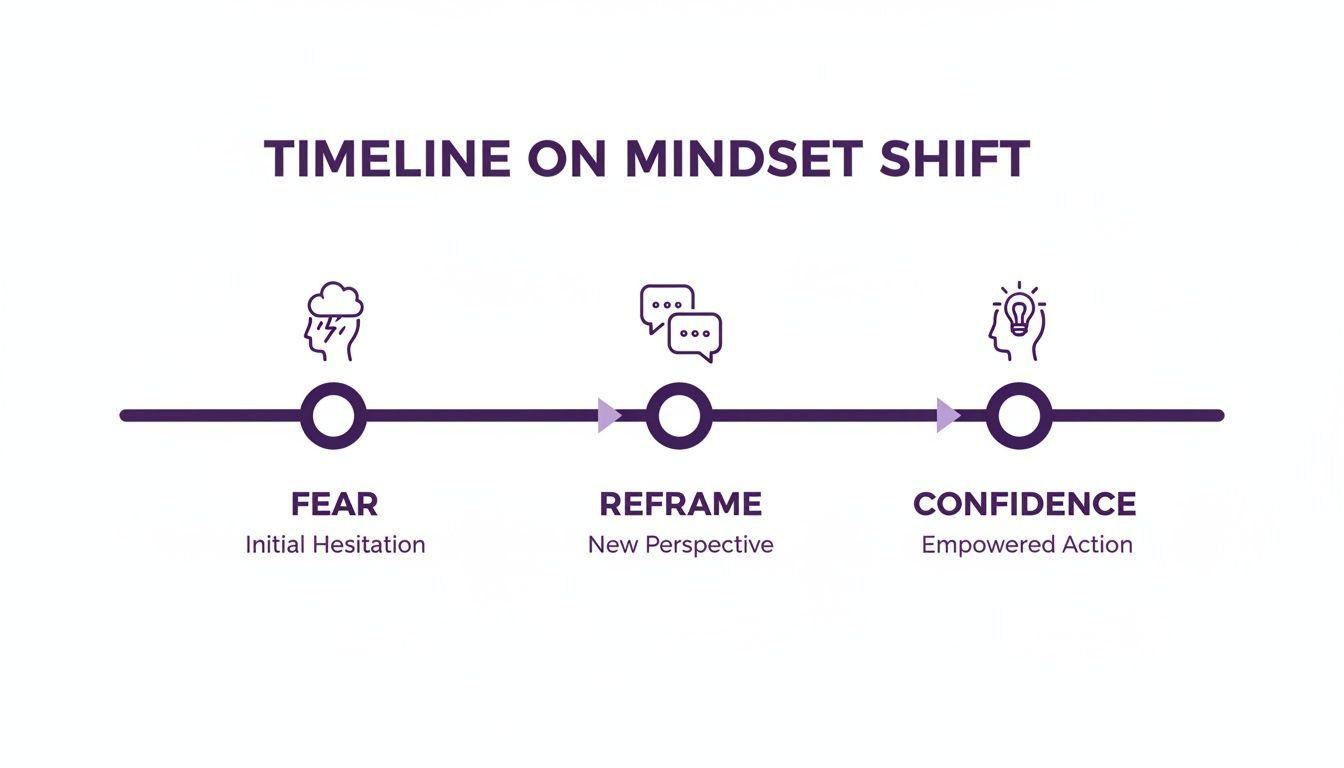
The big takeaway here is that confidence isn't something you start with; it's what you build through repetition and practice.
Desensitization Through Repetition
At its core, the mock interview works on a principle similar to exposure therapy. By facing a nerve-wracking situation over and over in a safe, controlled setting, you gradually desensitize yourself to it. Each practice run makes the next one feel a little less terrifying.
And this isn't just a feeling—it has a measurable impact. Studies show that practicing an interview 10-15 times can slash anxiety levels by 30-50%. That’s a massive drop that can completely change your performance. This repetition is how you turn a source of dread into just another conversation.
Proven Techniques to Calm Nerves on Interview Day

The research is done, you've practiced your answers, and now the day is here. And with it comes that familiar, gut-twisting wave of nerves. This is your body’s stress response kicking into overdrive, making your heart pound and your thoughts race.
The trick is to have a few simple, in-the-moment tools ready to go. These aren't complicated mental gymnastics—they're practical hacks designed to calm your nervous system, fast. By focusing on your body, you can quiet that anxious chatter in your mind and let your preparation shine. Think of it as hitting the physical reset button on your anxiety.
Master Your Breath to Master Your Nerves
When you get anxious, your breathing naturally becomes shallow and quick, which just screams "panic!" to your brain. Intentionally slowing down your breath is one of the fastest ways to break that cycle. The 4-7-8 breathing technique is an incredibly powerful tool for exactly this situation.
Here’s how to do it a few minutes before your interview kicks off:
- Inhale quietly through your nose for a count of four.
- Hold that breath for a count of seven.
- Exhale completely through your mouth—making a little "whoosh" sound—for a count of eight.
- Repeat this cycle three or four times.
This simple exercise physically forces your heart rate to slow down and kicks your parasympathetic nervous system (your body’s built-in relaxation response) into gear. It’s discreet enough to do in a waiting room or right before you click "join" on that video call.
Your breath is an anchor to the present moment. When your mind starts spiraling with "what ifs," focusing on the physical sensation of breathing in and out can pull you back from the edge of panic.
Establish a Calming Pre-Interview Routine
What you do in the hours leading up to the interview can make or break your mindset. Instead of cramming and frantically re-reading your notes (which only fuels anxiety), create a routine that’s all about calming your mind and body.
Your personal ritual could include things like:
- Smart Fuel: About an hour beforehand, eat a light meal with some protein and complex carbs to keep your blood sugar stable. Steer clear of too much caffeine or sugar—they’ll only amplify any jitters.
- Light Movement: A short, brisk walk outside can work wonders. The fresh air and physical activity help burn off that excess adrenaline and clear your head.
- Motivational Playlist: Put together a short playlist of songs that make you feel like a rockstar. Listen to it on the way there or while you’re getting ready.
Having a ritual gives you a sense of structure and control when everything else feels high-stakes. It shifts your focus from "what if I mess up?" to purposeful, calming action. These small steps are a surprisingly effective way to manage the physical side of anxiety and walk in feeling centered and ready.
Reduce Job Search Stress by Staying Organized
Let's be honest, interview anxiety doesn't just pop up out of nowhere. More often than not, it’s a symptom of a larger problem: the chaotic, messy energy of a disorganized job search. When your applications, notes, and follow-up reminders are scattered across a dozen spreadsheets, random documents, and a small mountain of sticky notes, you're living with a constant hum of low-level stress.
That disorganization is a real drain on your mental battery. Instead of using that precious energy to research the company or practice telling your best career stories, you’re stuck trying to remember which version of your resume you sent to which company. Getting that chaos under control is one of the most effective ways to lower your anxiety before you even step into the interview room.
From Chaos to Control with a Simple System
Imagine having a single, clear dashboard showing every application you've sent. You can see at a glance what’s pending, which interviews are on the calendar, and who you need to follow up with. This isn't some far-fetched dream; it's what a good organizational system gives you.
A simple Kanban board, for example, can be a total game-changer. It's a visual tool that lets you drag and drop your applications through different stages, like "Applied," "Interviewing," and "Offer." Each job gets its own card holding all the key details, completely replacing that mess of scattered notes with one central source of truth.
When your job search has a clear structure, you regain a powerful sense of control. This feeling of being in command of the process directly reduces the feeling of being overwhelmed, which is a key trigger for interview anxiety.
Work Smarter, Not Harder
A modern job search is loaded with repetitive admin work—tweaking resumes, writing cover letters, and tracking deadlines. While these tasks are necessary, they can feel like an absolute grind and lead straight to burnout. That leaves you with way less energy for the stuff that actually matters, like preparing to ace the interview. This is where dedicated tools can lift a massive weight off your shoulders.
For a deeper dive into structuring your search, check out our guide on using a job search organizer to streamline your efforts. Using smart tools for these tasks isn't about being lazy; it's about being strategic with your time and energy.
- Automate Resume Tailoring: Instead of manually rewriting your resume for every single application, modern tools can scan a job description and instantly highlight the most important skills and keywords to include.
- Generate First Drafts: An AI-powered generator can create a solid first draft of a cover letter in seconds. All you have to do is add your personal touch.
- Track Everything Automatically: A good system will pull job details, link to your documents, and maintain a clear timeline for you, cutting out all that tedious manual data entry.
By systemizing your job hunt, you free up a ton of mental and emotional bandwidth. You get to walk into each interview feeling composed and prepared, not frazzled from the administrative scramble that came before it. This is how you overcome interview anxiety by tackling one of its biggest root causes.
Got a Question About Interview Nerves?
Even the most prepared candidate has those last-minute "what if" moments. It’s totally normal. Knowing how to handle these common jitters when they pop up can make all the difference.
Let’s tackle some of the most common questions I hear from job seekers about keeping their cool.
What's the Best Way to Calm Down Right Before an Interview?
When you have only a few minutes to spare, your breath is your best friend. Seriously. Try the 4-7-8 method: breathe in for four seconds, hold that breath for seven, and then exhale slowly for eight. Just a few rounds of this can work wonders on a racing heart.
If you can, find a private spot for a minute—a restroom stall is perfect for this. Stand tall, plant your feet firmly, and put your hands on your hips. Hold that “power pose” for 60 seconds. It might feel a bit silly, but there’s real psychology behind it. It’s a quick-hitter for your confidence.
How Do I Stop My Mind from Going Blank on a Tough Question?
First off, don't panic. It happens to everyone. The key is to buy yourself a little time without looking rattled.
Just take a breath and say something simple like, "That's a great question, let me think about that for a moment." This little phrase is your lifeline. It shows you're thoughtful, not flustered, and gives you precious seconds to get your thoughts in order.
The best defense, though, is a good offense. This is where prepping stories using the STAR method pays off big time. When you’ve practiced telling your key career stories, they become second nature, making them easier to pull up even when you’re under pressure.
The goal isn’t to eliminate nerves entirely—it’s to have a game plan for when they show up. Taking a moment to think shows poise, not a lack of knowledge.
Should I Just Tell the Interviewer I’m Nervous?
I’d steer clear of this one. While it might feel honest, it can come across as a lack of confidence, and interviewers already expect you to be a little nervous anyway.
Instead of naming the feeling, try reframing it. If you feel like your nerves are really showing, you can always say something like, "I'm just really excited about this opportunity." This channels that shaky energy into something positive and then you can pivot right back to the conversation.
A solid organization system is your first line of defense against job search anxiety. With Eztrackr, you can manage every application, customize your resumes, and prep for interviews from one central hub. This frees up your brainpower to focus on what really matters—nailing the interview. Take control of your job hunt and get started with Eztrackr today.