How to Decline Job Offer: how to decline job offer gracefully
The simplest way to decline a job offer is with a prompt, polite, and professional email or phone call. The goal is to express gratitude for the opportunity, clearly state your decision, and wish the company well. Doing this well is key to maintaining a positive relationship for the future.
Why Turning Down a Job Offer Is a Smart Career Move
Getting a job offer feels great—it’s a major win in any job search. But automatically accepting isn’t always the right move. Knowing how to politely decline an offer is a surprisingly critical professional skill. It turns a potentially awkward conversation into a strategic career decision.
It’s really about having the self-awareness to recognize when an opportunity, no matter how good it seems, just doesn't line up with your long-term goals. Maybe you got a better offer, the company culture felt off, or the salary just wasn’t going to work.
Viewing this as an empowered choice, not a rejection, is the key. You're the one in the driver's seat of your career.
It Is More Common Than You Think
If you’re feeling a little guilty or nervous about turning down a job, don't. You're definitely not alone. The job market has changed, and candidates are being much more selective.
In fact, American candidates now have the lowest offer acceptance rate at just 79%. That means roughly one in five people turn down the offers they get. Job seekers today are actually 66% more likely to decline offers than they were before the pandemic. For anyone using a tool like Eztrackr to manage their search, this is crucial context. Saying "no" is a totally normal, and often necessary, part of finding the right fit.
Turning down a job offer isn't burning a bridge—it's building a path toward the right opportunity. A polite, professional "no" today keeps the door open for a potential "yes" tomorrow.
When you're lucky enough to be handling multiple job offers, knowing how to gracefully navigate the situation is what separates a good career move from a great one.
Key Reasons to Decline an Offer
Your reasons for saying "no, thanks" are your own, but they usually fall into a few common categories. Each scenario calls for a slightly different touch to communicate your decision while keeping that professional relationship intact.
The way you frame your "no" can leave a positive, lasting impression. If you need a deeper dive, check out our guide on how to evaluate job offers.
To help you strategize, here’s a quick breakdown of common reasons for declining and what your communication goal should be for each.
Reasons to Decline an Offer and Your Communication Goal
| Reason for Declining | Primary Communication Goal |
|---|---|
| Accepted a Better Offer | Convey excitement for your new role without diminishing their offer. |
| Poor Culture Fit | Be vague and positive, focusing on finding the "right environment." |
| Insufficient Compensation | Remain professional and appreciative, even if the numbers didn't work. |
| Role Isn't the Right Match | Emphasize long-term career goals and skill alignment elsewhere. |
| Received a Counteroffer | Show gratitude for their offer while reaffirming your decision to stay. |
No matter the reason, the objective is always the same: be clear, be grateful, and leave the door open for future possibilities.
Choosing the Right Way to Deliver the News
Deciding how to break the news is just as critical as the decision itself. You've really got two main channels: email or a phone call. Your choice here can leave a lasting impression on the hiring manager, so it's worth a moment of thought. Each one has its place, and the right one often depends on the relationship you've built with the company so far.
For most situations, sending an email is the standard, safest bet. It creates a clear, written record of your decision, so there's zero room for misunderstanding. This approach gives the hiring manager a moment to process the news without being put on the spot, which most people appreciate.
When to Make a Phone Call Instead
On the other hand, a phone call adds a personal touch that an email just can't replicate. This is the way to go when you've genuinely clicked with the recruiter or hiring manager over several interviews. If you’ve had some really good, in-depth conversations and feel a real connection, picking up the phone shows a tremendous amount of respect for their time and effort. It’s a nod to the relationship you've built and solidifies your professionalism.
A thoughtful phone call can turn what feels like a rejection into a genuine networking opportunity. It signals that you value the relationship beyond this single job opening, which can keep the door open for the future.
This little decision tree can help you figure out which path makes the most sense for your specific situation.
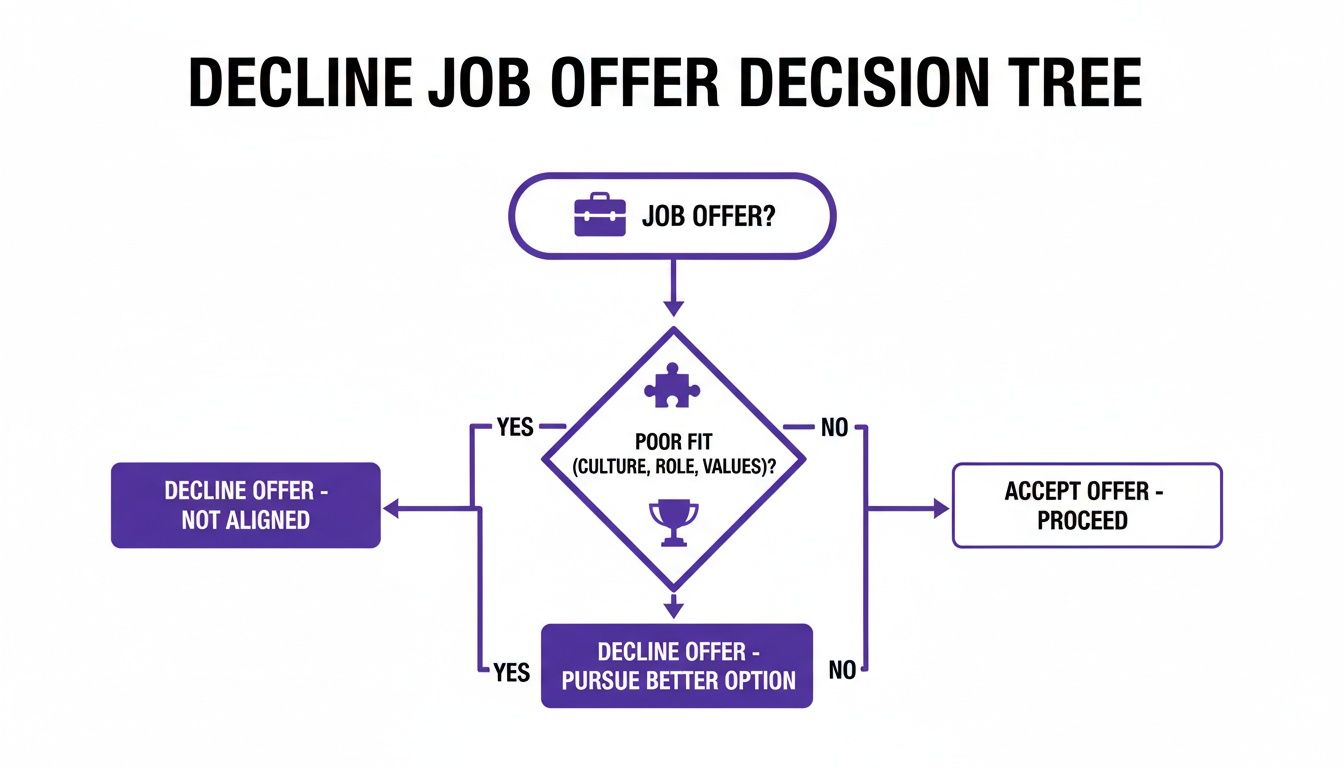
As you can see, major factors like realizing it's a poor culture fit or landing a much better offer are totally valid reasons to start this process.
The Best of Both Worlds: A Hybrid Approach
Here's a pro-tip: you don't actually have to choose just one. A hybrid approach often works wonders, combining the clarity of an email with the personal touch of a call.
Start by sending a concise, professional email that clearly states your decision to decline the offer. Then, in that same email, offer to hop on a quick call if they’d like to chat further. This gives the hiring manager the option to speak with you directly without making it a mandatory conversation. It’s a respectful move that shows you're open and transparent.
Navigating these professional moments well is a skill that pays dividends. For more advice, check out our guide on how to handle difficult conversations at work. This balanced technique ensures you’re remembered as a thoughtful and considerate professional, not just another candidate.
Email Templates for Declining an Offer with Class
Okay, so you need to turn down a job offer. It can feel like walking a tightrope, right? You want to be clear and direct, but you also don’t want to burn any bridges. The good news is, with the right approach, you can turn this potentially awkward moment into a professional win.
Think of it less as a "rejection" and more as a respectful, honest communication about where you're headed in your career.
The goal here isn't to give you rigid scripts to copy and paste. A generic email is easy to spot and can undo all the goodwill you’ve built. Instead, use these as frameworks and adapt them to reflect your own voice and the relationship you've formed with the recruiter or hiring manager.
To help you get it just right, let's break down the essential components of a great rejection email.
Anatomy of a Professional Rejection Email
Every solid email you send to decline an offer will have a few key ingredients. Here’s a quick look at what they are and why they matter.
| Email Section | Objective | Example Phrase |
|---|---|---|
| Clear Subject Line | Avoid confusion and ensure your email gets opened promptly. | "Job Offer – [Your Name]" or "Following up on the [Job Title] Offer" |
| Personalized Greeting | Address the hiring manager by name to show respect. | "Dear [Hiring Manager's Name]," |
| Expression of Gratitude | Thank them for their time and for the offer itself. | "Thank you so much for offering me the [Job Title] position…" |
| The Polite Decline | State your decision clearly but tactfully. | "After careful consideration, I have decided to decline this offer." |
| Brief, Professional Reason | Offer a concise, high-level reason (optional but recommended). | "…as I've accepted a role more aligned with my long-term goals." |
| Positive Closing | End on a high note, wishing them well. | "I truly enjoyed our conversations and wish you the best in finding a candidate." |
| Professional Sign-Off | Close the email appropriately. | "Best regards," or "Sincerely," |
Getting this structure right ensures you come across as gracious, professional, and thoughtful, even while delivering disappointing news.
Template for When You've Accepted a Better Offer
This is probably the most common scenario. The trick is to sound excited about your new role without making the other company feel like a consolation prize. Keep the focus on what's right for your career path.
Example Email:
Subject: Job Offer – [Your Name]
Dear [Hiring Manager's Name],
Thank you so much for offering me the [Job Title] position at [Company Name]. I sincerely appreciate you taking the time to speak with me and share more about this exciting opportunity.
After careful consideration, I have decided to accept another position that I feel is a better fit for my long-term career goals at this time.
This wasn't an easy decision, as I was truly impressed with the team and the vision for the role at [Company Name]. I wish you and the company all the best in finding a great candidate. I hope our paths cross again in the future.
Best regards,
[Your Name]
Why It Works: This email is positive, direct, and forward-looking. Citing "long-term career goals" is a professional and diplomatic reason that’s tough to argue with.
Template for When the Fit Isn't Right
Sometimes, a role looks perfect on paper, but your gut just tells you it's not the one. Maybe it's the company culture, the team dynamics, or the day-to-day responsibilities. When that happens, a little bit of vagueness is your best friend. You don't owe them a detailed critique of their company.
Example Email:
Subject: Regarding the [Job Title] Offer
Dear [Hiring Manager's Name],
Thank you again for the generous offer for the [Job Title] position. I truly enjoyed learning more about your team and the impactful work you are doing at [Company Name].
While I have the utmost respect for your team, I have decided to decline the offer at this time as I don't believe this role is the ideal fit for my career path right now.
I genuinely appreciate your time and consideration throughout this process. I wish you the best of luck in your search and hope we can stay in touch.
Sincerely,
[Your Name]
Template for Declining Due to Compensation
This one can feel tricky, especially if you’ve already tried to negotiate and couldn't meet in the middle. The goal is to remain professional and appreciative, leaving the door open for future possibilities. You never need to say, "You didn't offer me enough money." There are classier ways to phrase it.
- Be gracious: Always, always start with gratitude for the offer and their time.
- Be brief and professional: Don't get into the nitty-gritty of your financial situation.
- Keep it positive: Frame your decision around finding the right overall package, not just salary.
Example Email:
Subject: [Your Name] – [Job Title] Offer
Dear [Hiring Manager's Name],
Thank you very much for offering me the position of [Job Title] at [Company Name]. I deeply appreciate you and your team taking the time to interview me and discuss the role in detail.
After much thought, I have decided to decline this offer. While the opportunity is compelling, I have accepted another role that provides a compensation package more aligned with my current needs.
I was very impressed with [Company Name] and wish you all the best.
Warmly,
[Your Name]
Nailing communications like this is a crucial professional skill. If you want to brush up on the fundamentals, check out our guide covering professional email writing tips.
How to Handle the Rejection Phone Call with Confidence
Picking up the phone to decline a job offer feels way more daunting than shooting off an email, I get it. But honestly, it's often the classiest, most respectful move you can make. It shows real professionalism and honors the connection you've built with the hiring manager. The secret is just to get your thoughts in order before you dial.
Have a few key talking points ready. This isn't about reading from some stiff, robotic script. It’s about having a simple framework in your head so the conversation stays on track and you come across with poise. You want to be appreciative, clear, and quick.
This is a bigger deal than you might think, especially in crowded fields. Take the tech sector, for instance, where an average of 110 people apply for a single role. Companies often take around 48 days to fill a position. With hiring cycles that long, candidates are bound to get multiple offers. A polite, personal phone call is a gesture that will make you stand out and keep a valuable connection warm for the future.
For job seekers juggling multiple timelines in a tool like Eztrackr, turning a "no" into a positive interaction is a huge win for your network. You can dive deeper into hiring stats like these and discover key insights in the 2025 Global Recruitment Report on staffinghub.com.
Structuring Your Phone Conversation
To keep from rambling or getting flustered, think of the call in three simple parts: the appreciative opening, the clear decision, and the positive close. Each piece has a job to do in delivering the news gracefully.
-
The Opening: Jump right in with gratitude. Start with something like, "Hi [Hiring Manager's Name], it's [Your Name]. I'm calling about the [Job Title] offer. I wanted to start by saying thank you so much again for the opportunity; I really enjoyed our conversations."
-
The Decision: Be direct, but be kind. After the thank you, state your decision clearly. A great way to phrase it is, "This was a really tough decision for me, but I've decided to accept another role that feels like a stronger fit for my long-term career goals."
-
The Close: End things on a high note. Reiterate how much you appreciate them and say you'd love to stay in touch. "I was so impressed by [Company Name] and the whole team, and I truly hope our paths cross again down the road."
A prepared, respectful phone call does more than just decline an offer—it strengthens your professional network. The hiring manager will remember your courtesy, leaving a positive impression that could benefit you years from now.
Fielding Difficult Follow-Up Questions
The question you're almost guaranteed to get is, "Is there anything we can do to change your mind?" or "Was it about the compensation?" This is where your prep work really shines.
If they ask about changing your mind, a polite but firm response is your best bet. Try saying, "I'm very grateful for the offer, but I'm confident in my decision and have already committed to the other opportunity." This gently closes the door on a counteroffer without sounding dismissive.
What if they press you for a reason? Keep it high-level and professional. Stick to your line about career alignment or a better long-term fit. Whatever you do, don't get pulled into a conversation about negatives—the salary, the team, the company culture. It doesn't help anyone and can burn a bridge you might need later. Your goal is to leave the conversation with your professional reputation not just intact, but stronger than before.
When you’re deep in a job search, juggling a handful of applications, interviews, and potential offers can feel like its own full-time gig. It's a fantastic problem to have, but without a solid system, it’s shockingly easy for crucial details to fall through the cracks.
Forgetting a decision deadline or mixing up recruiter names are the kind of small stumbles that can, unfortunately, do real damage to your professional reputation.
This is exactly why having a systematic approach is non-negotiable. Knowing precisely where every application stands lets you communicate with total confidence—especially when it's time to turn down an offer. A dedicated job tracking tool brings some much-needed order to the chaos. For a closer look at this, you can learn more about how to track job applications with a dedicated system.
Visualize Your Entire Job Pipeline
The real magic of an organized search is being able to see everything at a glance. Instead of digging through a messy spreadsheet or a pile of scattered notes, a tool with a Kanban board view can completely change the game.
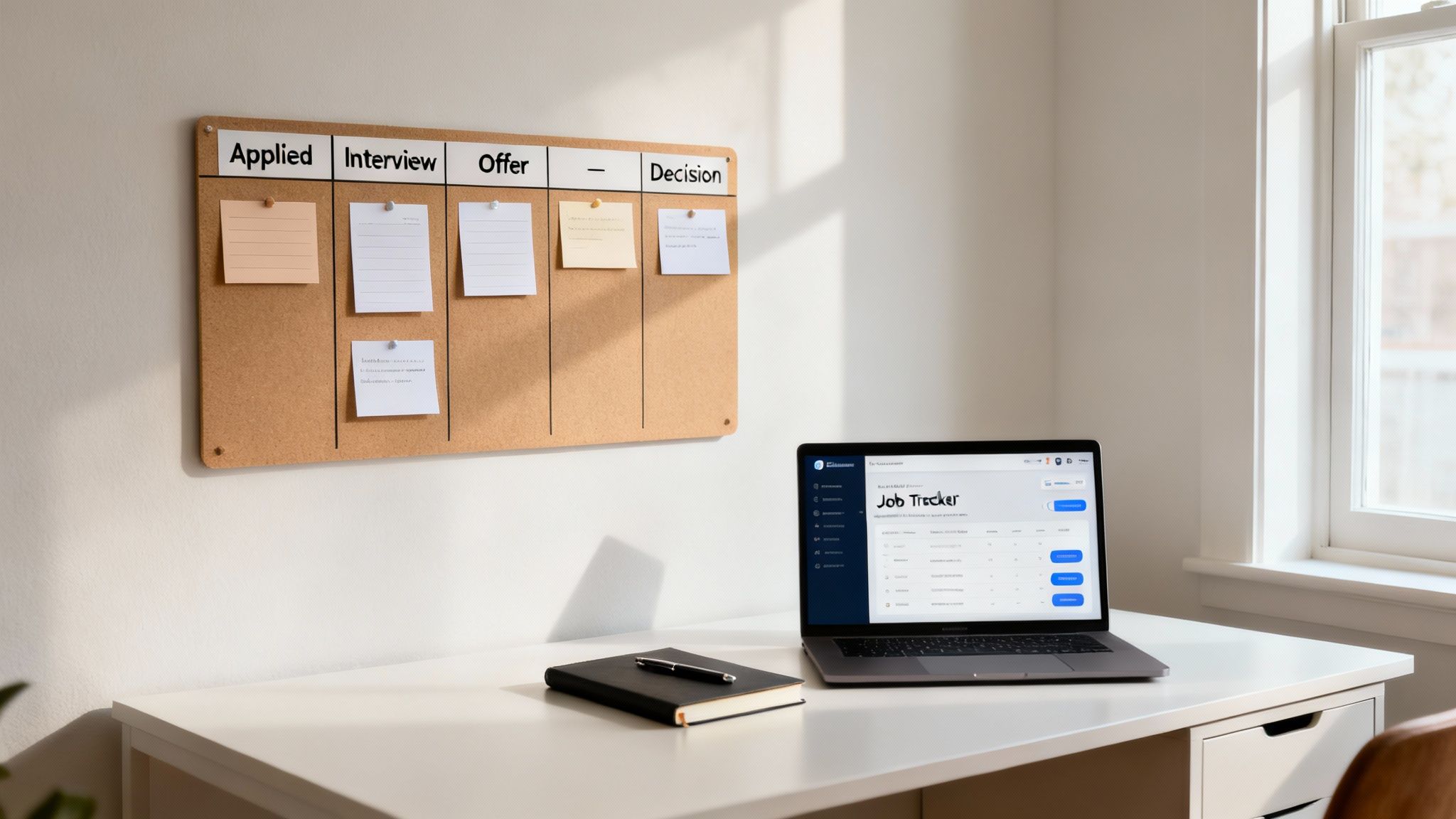
This kind of visual layout lets you see your entire pipeline in one go, from the first application all the way to the final offer. You can instantly spot which opportunities need a follow-up and which offers need a decision, fast.
This level of clarity is what separates a smooth process from a stressful one. It ensures every single communication—including the delicate task of declining a job offer—is handled perfectly and on time. You can log all the key details for each offer, like:
- Compensation and Benefits: Keep the full package for every offer straight so you can easily compare them.
- Decision Deadlines: Never miss a critical date that could put you in an awkward spot.
- Recruiter Contact Info: Have all the names, titles, and emails organized and ready to go.
- Key Conversation Notes: Jot down important points from interviews that can help you personalize your decline.
An organized job search isn't just about being efficient; it's about protecting your professional brand. A clear system prevents embarrassing mix-ups and empowers you to manage multiple opportunities with grace.
To truly master your job search, you need a clear strategy for finding the right roles from the start. As you continue to explore job opportunities, a well-managed pipeline allows you to make strategic decisions, ensuring you accept the right role and decline others with professionalism and respect.
Got Questions? Let's Talk Through Some Tricky Scenarios
Even with the best game plan, things can get… weird. What if they throw a counteroffer at you? What if you already said "yes" verbally? These are the moments that can really trip you up.
Don't worry, we've seen it all. Let's walk through a few of the most common curveballs so you can handle them like a pro, keeping your reputation intact and your stress levels down.
What Should I Do If They Make a Counteroffer?
First off, take a breath and a quick pat on the back. A counteroffer is a huge compliment. But it can also be a really awkward spot to be in, especially if your mind is already made up.
Your first move is simple: listen. Hear them out completely, and then thank them for their willingness to negotiate. It shows you respect their effort.
Even if you are 100% certain you're still going to decline, ask for a little time to think it over—even just an hour or two. It's a small gesture that goes a long way and prevents you from looking dismissive.
When you get back to them, gently but firmly stick to your original decision.
You can say something like, "I really appreciate you putting this new offer together, and it says a lot about how much you value your team. I've had a chance to think it over, but my decision was based on a few factors beyond salary, so I'm going to stick with my plan to accept the other opportunity."
Being gracious but firm is the name of the game here. It prevents a long, drawn-out back-and-forth and keeps the relationship positive.
Is It Okay to Decline After a Verbal Acceptance?
Oof. This is a tough one. Backing out after you've given a verbal "yes" is a serious move that can burn a bridge, so this should only be for absolute, last-resort situations.
If you absolutely must do this, email won't cut it. You have to pick up the phone, and you have to do it immediately. The longer you wait, the worse it gets for everyone.
Get straight to the point. Start with a sincere apology for the news you're about to deliver. Then, give a very brief, honest reason without making a bunch of excuses.
For example: "Hi [Hiring Manager's Name], I'm calling with some difficult news and I want to start by sincerely apologizing. An unexpected personal situation has come up, and unfortunately, I need to retract my verbal acceptance of the offer."
A quick, direct, and honest phone call is your only real option to minimize the damage and show respect for their time and effort.
Do I Have to Explain Why I Am Declining?
Nope. You're not required to give them a detailed debrief. A simple, polite "no, thank you" is completely professional. Honestly, sometimes less is more.
A great all-purpose line is: "After giving it a lot of thought, I've decided to accept another role that I feel is a better match for my long-term career goals." It’s professional, positive, and doesn’t really invite a ton of follow-up questions.
Now, if you genuinely liked the team and the reason is something simple and constructive (like the commute was just too far, or the role wasn't quite the right scope), it can be a nice gesture to share that. Just steer clear of any negative feedback on the salary, the interview process, or the people you met. That kind of criticism rarely lands well and can turn a good connection sour.
Juggling multiple offers, timelines, and these kinds of tricky conversations can feel like a full-time job in itself. Instead of letting it get chaotic, you can use a tool like Eztrackr to keep all your applications, notes, and deadlines organized in one clean dashboard. Stop drowning in spreadsheets and start managing your job search with a clear head. Try Eztrackr for free and feel the difference.